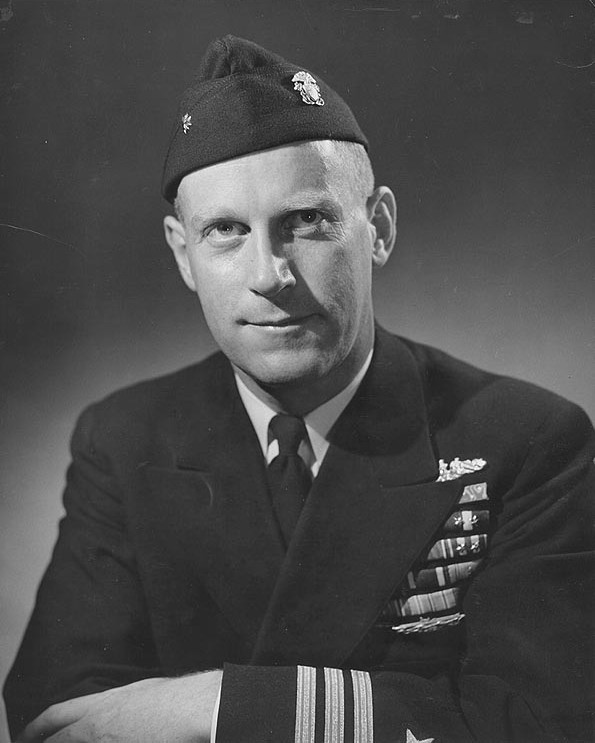
Cdr, U.S. Navy — World War II
Richard Hetherington O’Kane was born on February 2, 1911, in Dover, New Hampshire, the youngest of four children of a University of New Hampshire professor. He graduated from Phillips Academy and the U.S. Naval Academy in 1934, served on surface ships, and qualified in submarines aboard USS Argonaut in 1938.
When war came, O’Kane became executive officer of the new submarine USS Wahoo and made five war patrols, most of them under the legendary Commander Dudley “Mush” Morton, who taught him to run the attack plots himself while his executive officer manned the periscope. In October 1943 O’Kane took command of USS Tang. In five patrols, Tang rescued 22 downed airmen off Truk in a single mission and sank more Japanese shipping than any other American submarine — officially credited with 24 ships totaling 93,824 tons, a figure later review of Japanese records raised to 33 ships. Altogether O’Kane earned three Navy Crosses and three Silver Stars in addition to the Medal of Honor.
The Medal of Honor came for Tang’s fifth and final patrol. On October 23 and 24, 1944, in waters near the Philippines, O’Kane twice took Tang on the surface into the middle of heavily escorted Japanese convoys, standing on his bridge amid fire from all directions while his torpedoes smashed into tankers, transports, and a destroyer. Firing her last torpedoes in the second attack, Tang was struck by one of her own weapons, which had made a circular run and come back at her. The submarine went down with 78 of her 87 men. O’Kane was one of nine survivors, pulled from the water by a Japanese frigate, and he spent the remaining ten months of the war as a prisoner, coming home weighing less than 100 pounds.
O’Kane stayed in the Navy after the war, testified at Japanese war crimes trials, commanded submarine forces, and retired in 1957 as a rear admiral. He recounted his patrols in the books Clear the Bridge! and Wahoo. He died on February 16, 1994, in Petaluma, California, and is buried at Arlington National Cemetery. The destroyer USS O’Kane (DDG-77) is named for him, and his personal cribbage board — a good-luck relic from his Wahoo days — is still carried aboard the oldest fast-attack submarine in the Pacific Fleet.
Sources: Wikipedia · Congressional Medal of Honor Society